
SSDT: Scale-Separation Semantic Decoupled Transformer for Semantic Segmentation of Remote Sensing Images
Transformer-based separation of scale and semantic context
IEEE Journal of Selected Topics in Applied Earth Observations and Remote Sensing, 2024
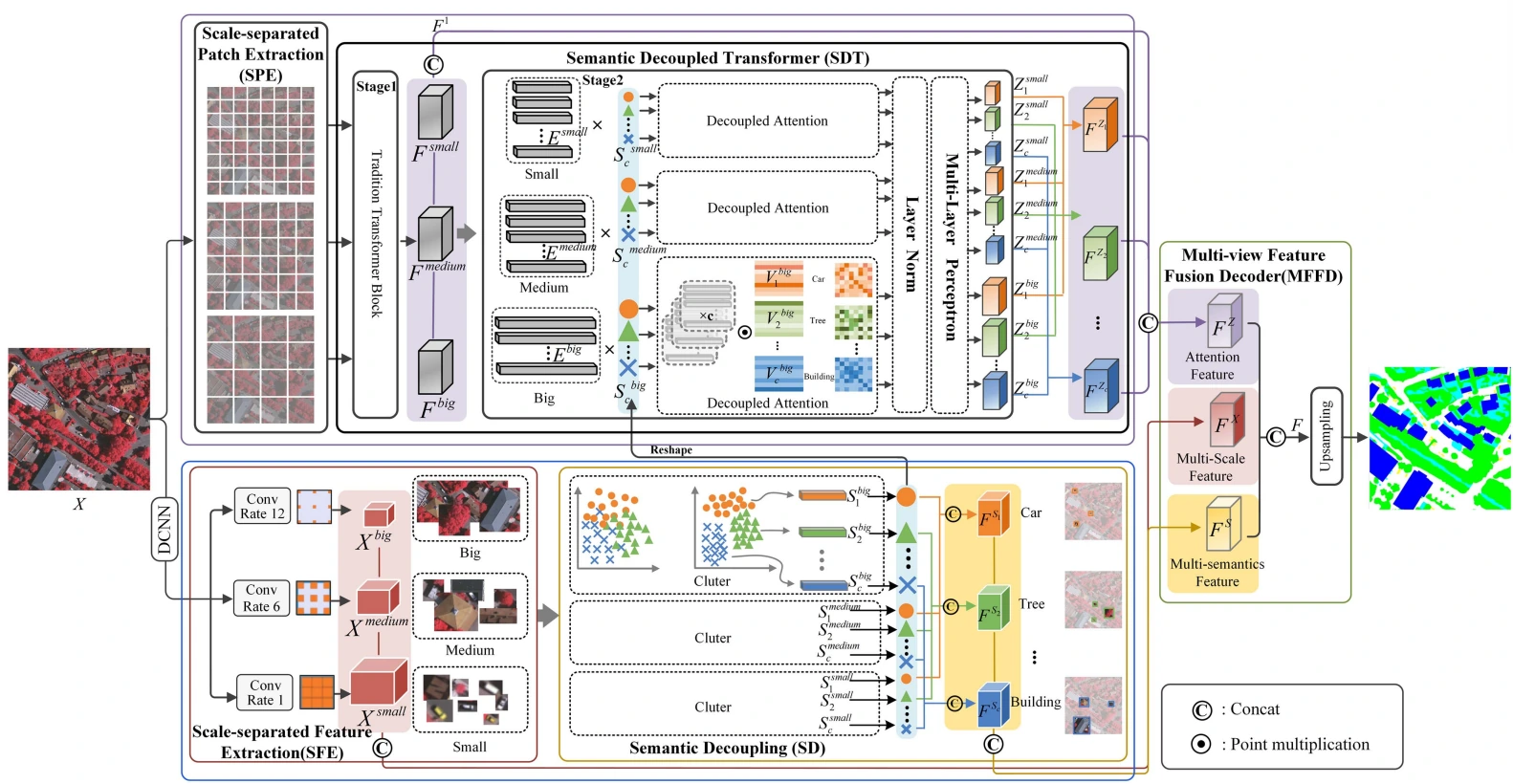
SSDT method overview supplied by the project author.
I. Overview
Remote-sensing scenes combine large geographic structures with small, densely arranged objects. SSDT uses transformer components to separate scale-sensitive representations from semantic context and then coordinate them for pixel-level prediction.
II. Key Contributions
- Introduces scale-separation modules for heterogeneous object sizes.
- Decouples semantic interactions to reduce interference among scene categories.
- Uses transformer attention to integrate long-range context into segmentation.
III. Methodology
Multi-level visual features enter scale-separation and semantic-decoupling stages. Transformer attention models interactions within the refined representations, and a decoder fuses the resulting features to produce the final segmentation map.
IV. Research Focus
The method is intended to preserve fine spatial detail while using broad scene context, especially when the same semantic category appears at markedly different scales.
Reference
Citation
BibTeX citation
@article{zheng2024ssdt,
  title={SSDT: Scale-separation semantic decoupled transformer for semantic segmentation of remote sensing images},
  author={Zheng, Chengyu and Jiang, Yanru and Lv, Xiaowei and Nie, Jie and Liang, Xinyue and Wei, Zhiqiang},
  journal={IEEE Journal of Selected Topics in Applied Earth Observations and Remote Sensing},
  volume={17},
  pages={9037--9052},
  year={2024},
  publisher={IEEE}
}
Continue exploring
Related Projects
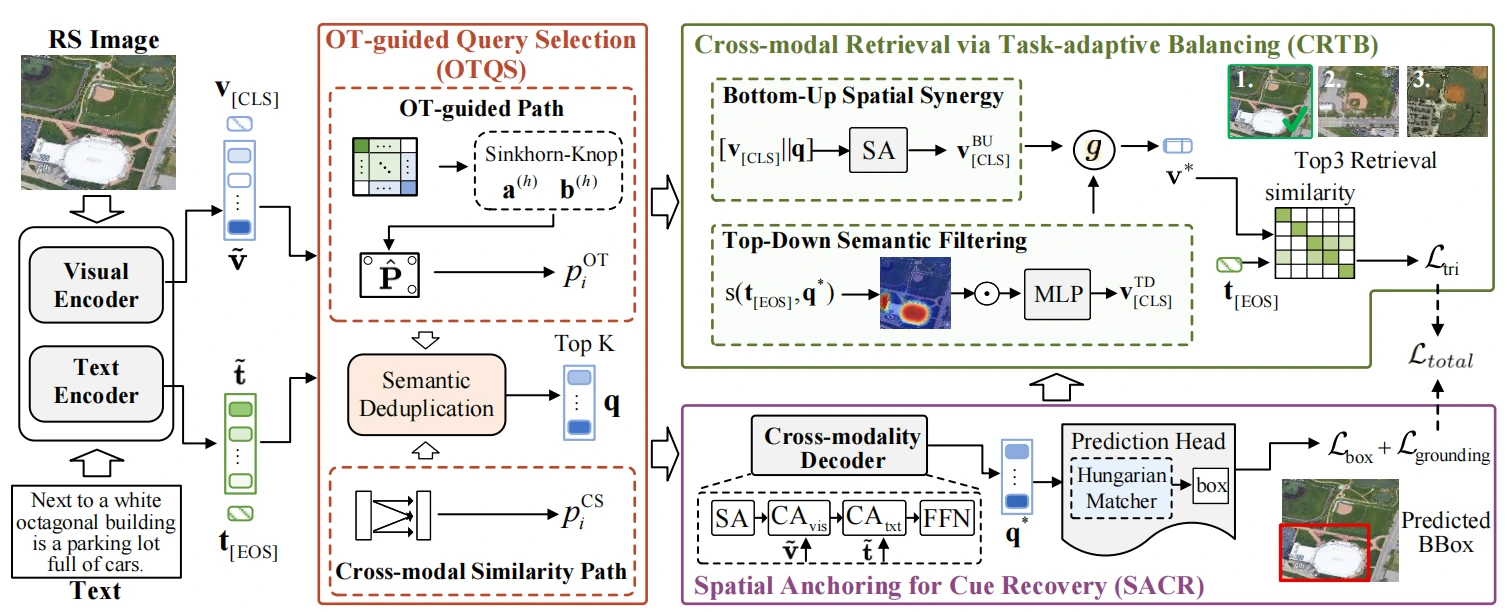
Explicit Spatial Localization and Task-Adaptive Balancing for Remote Sensing Image-Text Retrieval
A remote-sensing image–text retrieval framework that combines explicit object localization with adaptive coordination between spatial and semantic learning objectives.
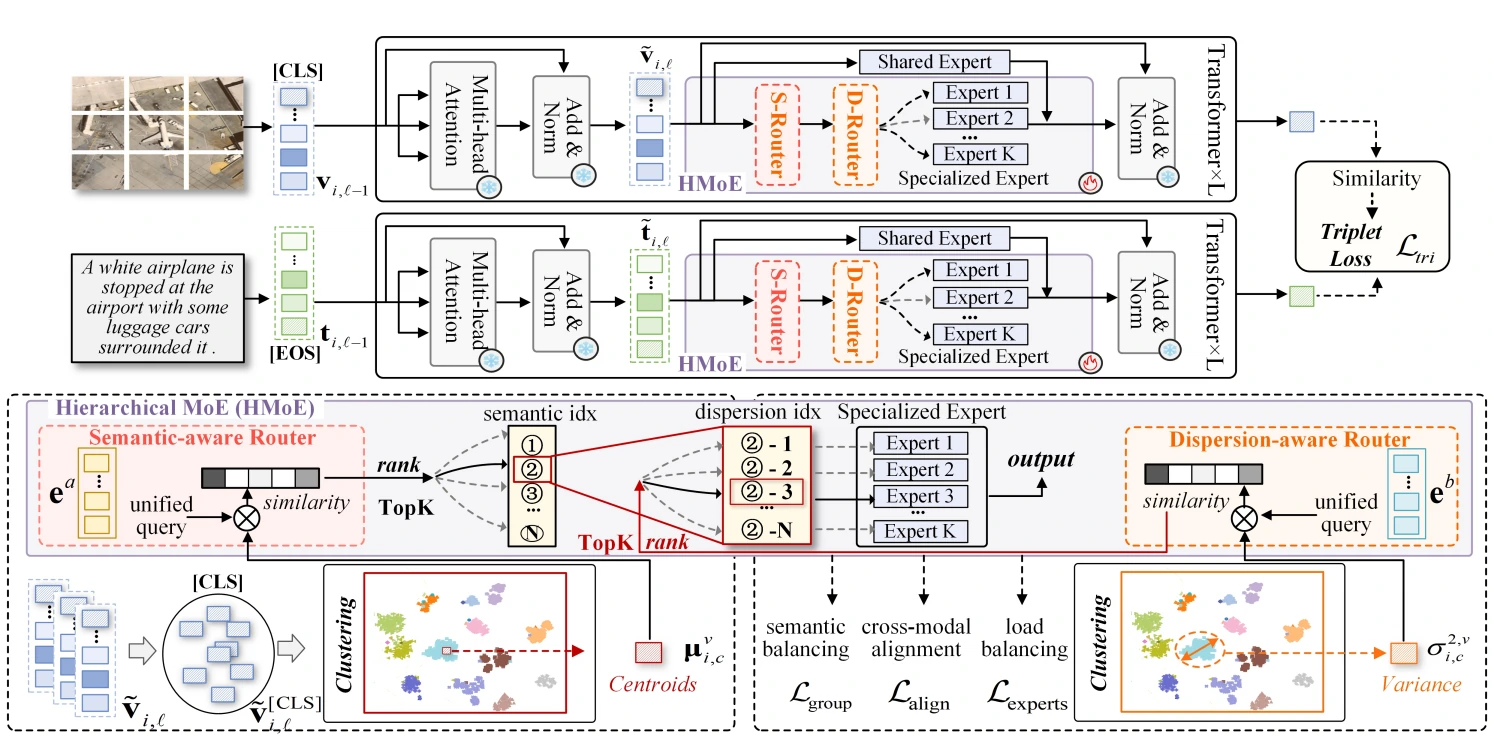
H-MoC: Hierarchical Mixture-of-Experts for Semantic- and Dispersion-Consistency in Remote Sensing Image-Text Retrieval
A hierarchical mixture-of-experts retrieval framework that promotes both semantic consistency and balanced feature dispersion across remote-sensing image and text representations.