
JVLGS: Joint Vision–Language Gas Leak Segmentation
Language-guided temporal-spatial reasoning for gas leak segmentation
The Visual Computer, 2026
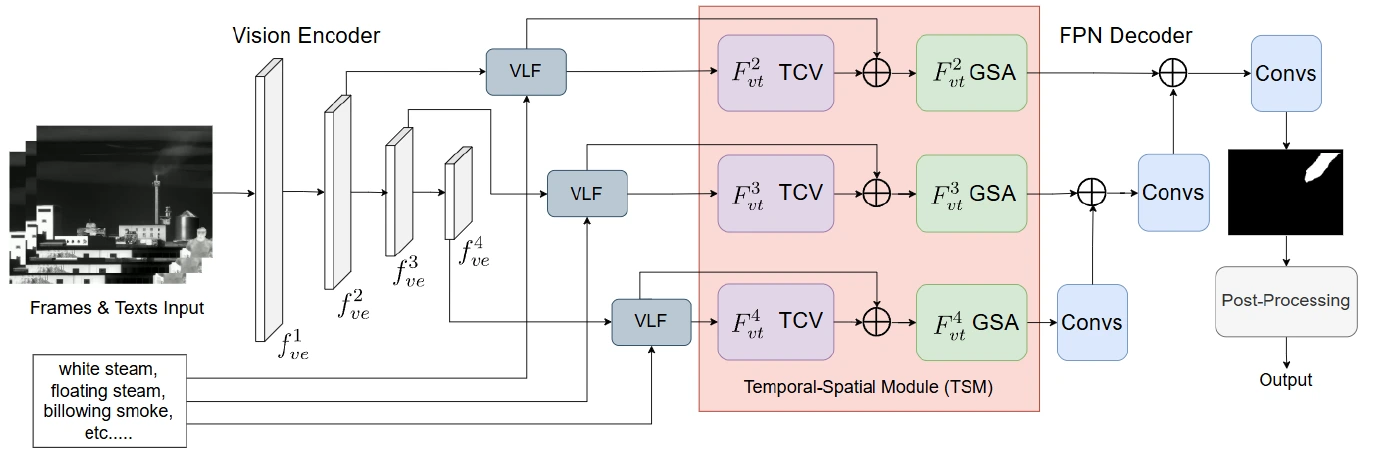
JVLGS framework overview supplied by the project author.
I. Overview
Gas plumes are transparent, deform continuously, and often blend into complex backgrounds. JVLGS brings language guidance into video segmentation so the model can combine visual motion with semantic descriptions of the target.
The framework is evaluated in conventional supervised training as well as limited-data settings where language guidance can provide useful additional context.
II. Key Contributions
- Combines visual video features and text prompts in a unified gas-leak segmentation framework.
- Captures spatial and temporal evidence to distinguish faint moving plumes from background appearance changes.
- Adds adaptive post-processing to suppress false-positive regions and stabilize predicted masks.
III. Methodology
JVLGS extracts complementary features from consecutive video frames and a language prompt, fuses them through a joint vision–language architecture, and applies temporal-spatial reasoning before producing the segmentation mask. Adaptive post-processing removes unlikely detections.
IV. Main Findings
The reported experiments show competitive gas-leak segmentation in fully supervised settings and useful generalization when only a small amount of labeled training data is available.
Reference
Citation
BibTeX citation
@article{Zhao2026JVLGS,
  author  = {Zhao, Xinlong and Pang, Qixiang and Du, Shan},
  title   = {JVLGS: Joint Vision--Language Gas Leak Segmentation},
  journal = {The Visual Computer},
  year    = {2026},
  volume  = {42},
  number  = {10},
  article = {428},
  doi     = {10.1007/s00371-026-04591-y},
  url     = {https://doi.org/10.1007/s00371-026-04591-y}
}
Continue exploring
Related Projects
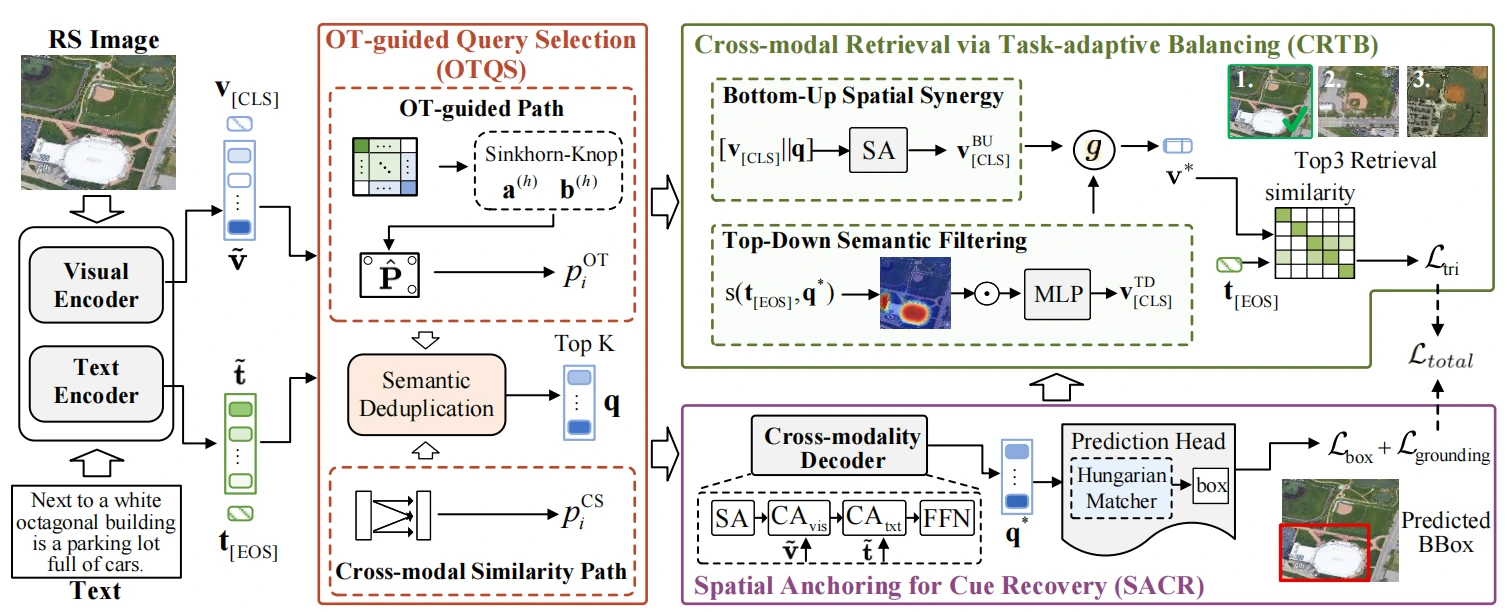
Explicit Spatial Localization and Task-Adaptive Balancing for Remote Sensing Image-Text Retrieval
A remote-sensing image–text retrieval framework that combines explicit object localization with adaptive coordination between spatial and semantic learning objectives.
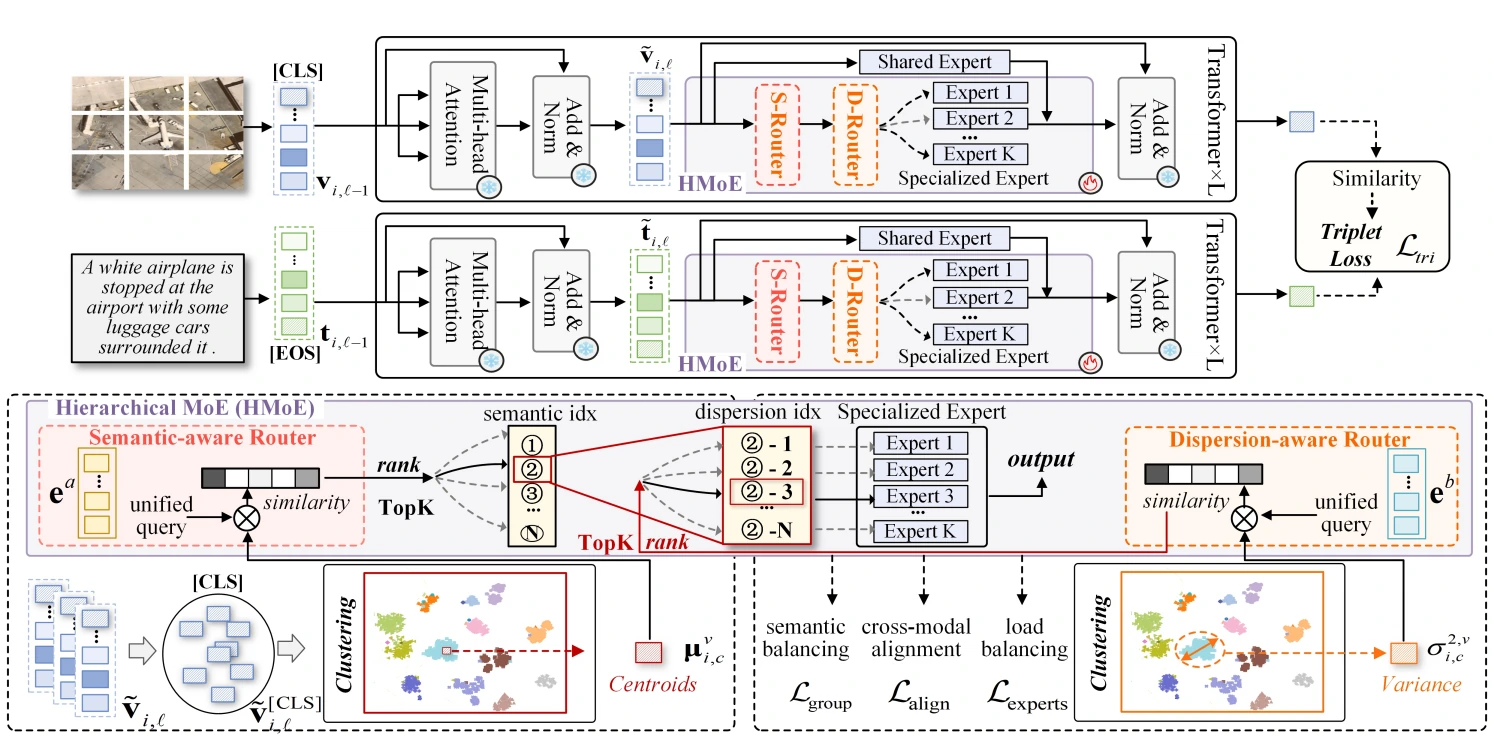
H-MoC: Hierarchical Mixture-of-Experts for Semantic- and Dispersion-Consistency in Remote Sensing Image-Text Retrieval
A hierarchical mixture-of-experts retrieval framework that promotes both semantic consistency and balanced feature dispersion across remote-sensing image and text representations.