
High-Order Semantic Decoupling Network for Remote Sensing Image Semantic Segmentation
Separating high-order semantic relationships for dense scene understanding
IEEE Transactions on Geoscience and Remote Sensing, 2023
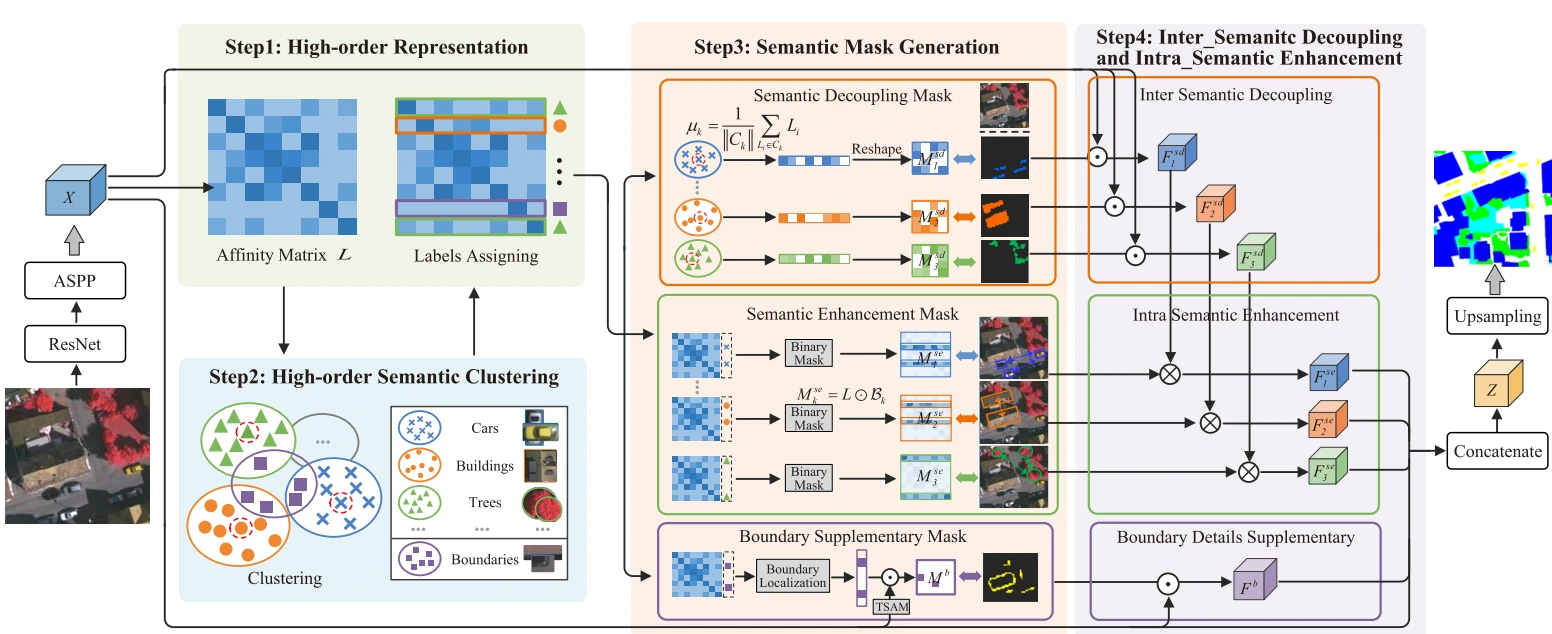
Method overview supplied by the project author.
I. Overview
Dense remote-sensing segmentation must distinguish visually similar regions while preserving relationships across large spatial extents. This project decouples high-order semantic interactions so the model can reason about complementary contextual structures without collapsing them into one feature stream.
II. Key Contributions
- Models high-order dependencies among semantic regions in remote-sensing scenes.
- Separates complementary contextual relationships before feature aggregation.
- Recombines decoupled semantics for pixel-level classification.
III. Methodology
A convolutional feature extractor supplies multi-level visual representations. The semantic-decoupling stages shown in the supplied overview build and separate higher-order contextual relationships, then fuse the refined features into a dense segmentation prediction.
IV. Research Focus
The method targets scenes where local appearance alone is ambiguous and broader semantic context is needed to assign consistent land-cover labels.
Reference
Citation
BibTeX citation
@article{zheng2023high,
  title={High-order semantic decoupling network for remote sensing image semantic segmentation},
  author={Zheng, Chengyu and Nie, Jie and Wang, Zhaoxin and Song, Ning and Wang, Jingyu and Wei, Zhiqiang},
  journal={IEEE Transactions on Geoscience and Remote Sensing},
  volume={61},
  pages={1--15},
  year={2023},
  publisher={IEEE}
}
Continue exploring
Related Projects
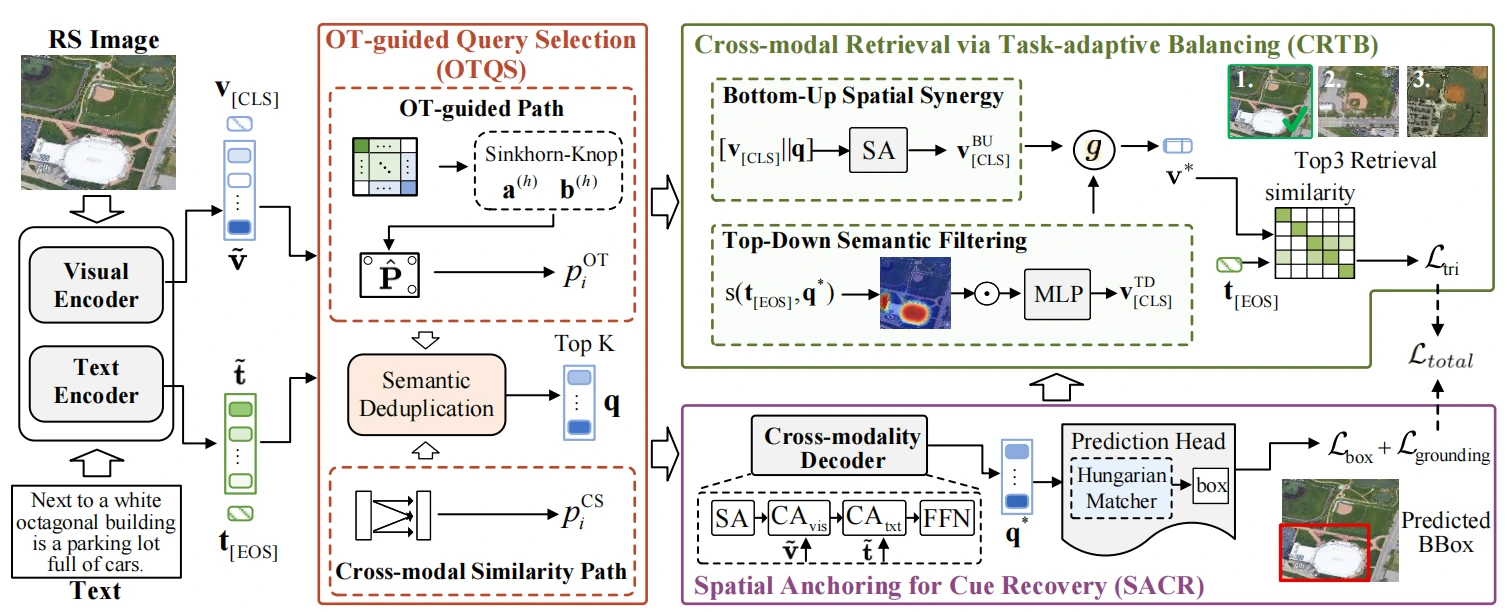
Explicit Spatial Localization and Task-Adaptive Balancing for Remote Sensing Image-Text Retrieval
A remote-sensing image–text retrieval framework that combines explicit object localization with adaptive coordination between spatial and semantic learning objectives.
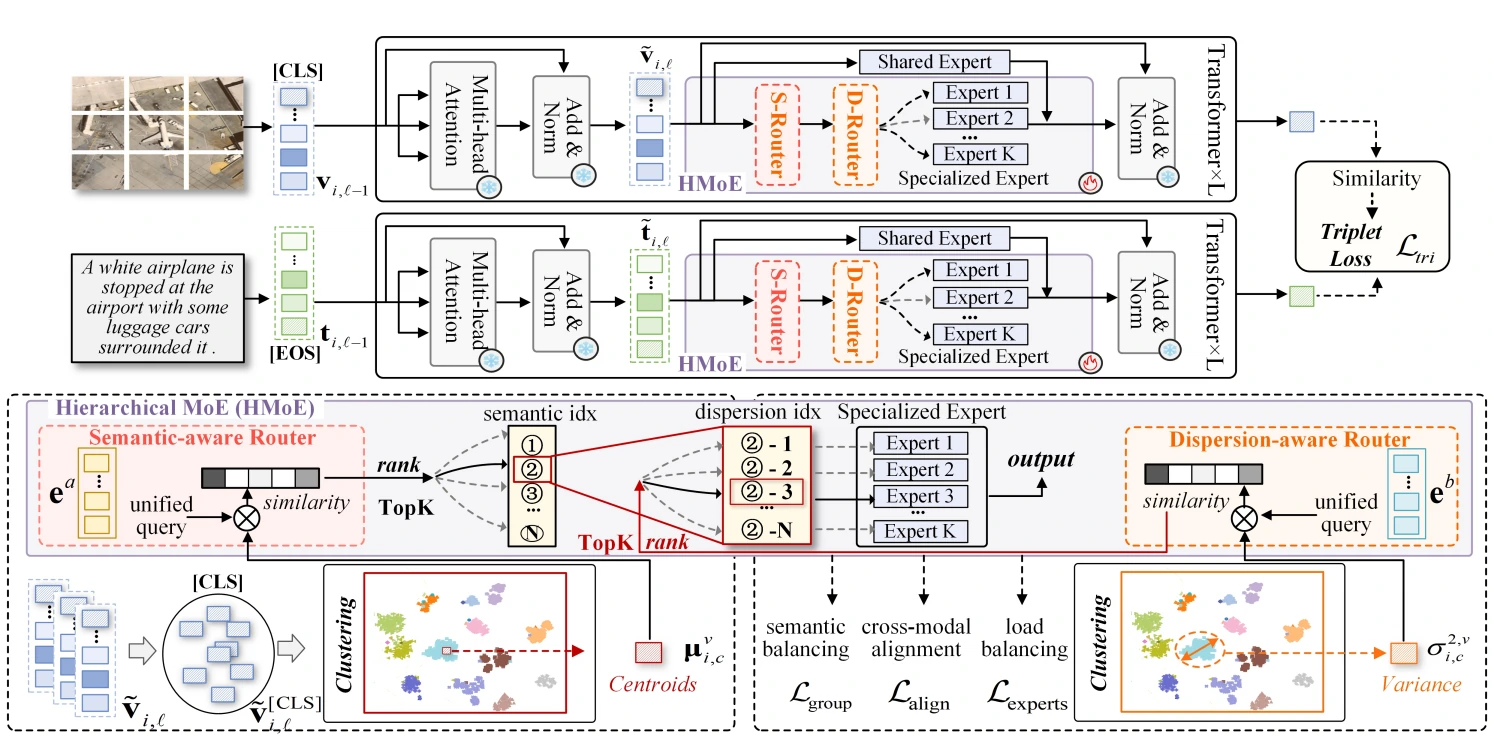
H-MoC: Hierarchical Mixture-of-Experts for Semantic- and Dispersion-Consistency in Remote Sensing Image-Text Retrieval
A hierarchical mixture-of-experts retrieval framework that promotes both semantic consistency and balanced feature dispersion across remote-sensing image and text representations.